Chair
|
Sergio Rajsbaum,
Compaq CRL/UNAM, USA/Mexico |
[Top] [Home] [All LATIN Chairs]
Program Committee
|
Amihood Amir, Bar-Ilan Univ., Israel Mauricio Ayala Rincón, Brazilia Univ., Brazil Ricardo Baeza-Yates, Univ. of Chile, Chile Michael Bender, SUNY Stony Brook, USA Leopoldo Bertossi, Carleton Univ., Canada Allan Borodin, Univ. of Toronto, Canada Bernard Chazelle, Princeton Univ., USA Lenore Cowen, Tufts Univ., USA Volker Diekert, Stuttgart, Germany Javier Esparza, Univ. of Edimburgh, Scotland Martin Farach-Colton, Rutgers Univ., USA David Fernandez-Baca, Iowa State Univ., USA Esteban Feuerstein, Univ. of Buenos Aires, Argentina Juan Garay, Bell Labs, USA Oscar H. Ibarra, UC Santa Barbara, USA Marcos Kiwi, Univ. of Chile, Chile Yoshiharu Kohayakawa, Univ. de São Paulo, Brasil Elias Koutsoupias, UC Los Angeles, USA Evangelos Kranakis, Carleton Univ., Canada Daniel Leivant, Indiana Univ., USA Alex Lopez-Ortiz, Univ. of Waterloo, Canada Yoram Moses, Technion, Israel Daniel Panario, Carleton Univ., Canada Sergio Rajsbaum (Chair), Compaq CRL and UNAM, Mexico Alex Russell, Univ. Connecticut, USA Maria José Serna, Univ. Politècnica de Catalunya, Spain Gadiel Seroussi, Hewlet Packard, USA Igor Shparlinski, Macquarie Univ., Australia Imre Simon, Univ. de São Paulo, Brasil Janos Simon, Univ. of Chicago, USA |
[Top] [Home] [All LATIN PCs]
Organizing Committee
|
Edgar Chávez (chair),
Universidad Michoacana, México Sergio Rajsbaum, Compaq/UNAM, USA/México |
[Top] [Home] [All LATIN Org. Committees]
Invited Speakers
Jennifer T. Chayes
(Microsoft Research), Phase Transitions in Computer SciencePhase transitions are familiar phenomena in physical systems. But they also occur in many probabilistic and combinatorial models, including random versions of some classic problems in theoretical computer science.Christos H. Papadimitriou (U. California, Berkeley), The Internet, the Web, and Algorithms The Internet and the worldwide web, unlike all other computational artifacts, were not deliberately designed by a single entity, but emerged from the complex interactions of many. As a result, they must be approached very much the same way that cells, galaxies or markets are studied in other sciences: By speculative (and falsifiable) theories trying to explain how selfish algorithmic actions could have led to what we observe. I present several instances of recent work on this theme, with several collaboratorsJoel Spencer (Courant Institute), Erdős Magic The Probabilistic Method is a lasting legacy of the late Paul Erdős. We give two examples — both problems first formulated by Erdős in the 1960s with new results in the last few years and both with substantial open questions. Further in both examples we take a Computer Science vantagepoint, creating a probabilistic algorithm to create the object (coloring, packing respectively) and showing that with positive probability the created object has the desired properties.Jorge Urrutia (UNAM), Open Problems in Computational Geometry In this paper we present a collection of problems which have defied solution for some time. We hope that this paper will stimulate renewed interest in these problems, leading to solutions to at least some of them.Umesh V. Vazirani (U. California, Berkeley), Quantum Algorithms Quantum computers are the only model of computing to credibly violate the modified Church-Turing thesis, which states that any reasonable model of com-putation can be simulated by a probabilistic Turing Machine with at most poly-nomial factor simulation overhead. This is dramatically demonstrated by Shor’s polynomial time algorithms for factorization and discrete logarithms [13]. Shor’s algorithm, as well as the earlier algorithm due to Simon [12] can both be cast into the general framework of the hidden subgroup problem (see for example [10]). Two recent papers [11], [9] study how well this framework extends to solving the hidden subgroup problem for non-abelian groups (which includes the graph iso-morphism problem). |
[Top] [Home] [All LATIN Inv. Speakers]
Papers
|
Jennifer Chayes, Phase Transitions in Computer Science. [Bibtex]
Christos Papadimitriou, The Internet, the Web, and Algorithms. [Bibtex] Joel Spencer, Erdős Magic. [Bibtex] Jorge Urrutia, Open Problems in Computational Geometry. [Bibtex] Umesh V. Vazirani, Quantum Algorithms. [Bibtex] Mihalis Yannakakis, Testing and Checking of Finite State Systems. [Bibtex] Fabrizio Luccio and Linda Pagli, From Algorithms to Cryptography. [Bibtex] Eric Goubault and Martin Raussen, Dihomotopy as a Tool in State Space Analysis. [Bibtex] Abdullah N. Arslan and Ömer Egecioglu, Algorithms for Local Alignment with Length Constraints. [Bibtex] Marília D. V. Braga and Joao Meidanis, An Algorithm That Builds a Set of Strings Given Its Overlap Graph. [Bibtex] Christiane Frougny, Conversion between Two Multiplicatively Dependent Linear Numeration Systems. [Bibtex] Sylvain Lombardy and Jacques Sakarovitch, Star Height of Reversible Languages and Universal Automata. [Bibtex] Howard Straubing and Denis Thérien, Weakly Iterated Block Products of Finite Monoids. [Bibtex] Maria Isabel Gonzalez Vasco, Mats Näslund and Igor Shparlinski, The Hidden Number Problem in Extension Fields and Its Applications. [Bibtex] Theodoulos Garefalakis, The Generalized Weil Pairing and the Discrete Logarithm Problem on Elliptic Curves. [Bibtex] Rod Canfield, Sylvie Corteel and Pawel Hitczenko, Random Partitions with Non Negative rth Differences. [Bibtex] Frédérique Bassino, Beta-Expansions for Cubic Pisot Numbers. [Bibtex] Prosenjit Bose and Qingda Wang, Facility Location Constrained to a Polygonal Domain. [Bibtex] Hanno Lefmann and Niels Schmitt, A Deterministic Polynomial Time Algorithm for Heilbronn's Problem in Dimension Three. [Bibtex] Edgar Chávez and Gonzalo Navarro, A Metric Index for Approximate String Matching. [Bibtex] Wojciech Rytter, On Maximal Suffices and Constant-Space Linear-Time Versions of KMP Algorithm. [Bibtex] Derek G. Corneil, Feodor F. Dragan and Ekkehard Köhler, On the Power of BFS to Determine a Graphs Diameter. [Bibtex] Martín Matamala, Erich Prisner and Ivan Rapaport, \(k\)-pseudosnakes in Large Grids. [Bibtex] Tiziana Calamoneri and Rossella Petreschi, \(L(2, 1)\)-Coloring Matrogenic Graphs. [Bibtex] Ruy Luiz Milidiú, Artur Alves Pessoa and Eduardo Sany Laber, Pipeline Transportation of Petroleum Products with No Due Dates. [Bibtex] Enrico Pontelli and Desh Ranjan, Ancestor Problems on Pure Pointer Machines. [Bibtex] Renato Carmo, Jair Donadelli, Yoshiharu Kohayakawa and Eduardo Sany Laber, Searching in Random Partially Ordered Sets. [Bibtex] Brett Stevens and Eric Mendelsohn, Packing Arrays. [Bibtex] Michael Drmota and Wojciech Szpankowski, Generalized Shannon Code Minimizes the Maximal Redundancy. [Bibtex] S. Muthukrishnan and Cenk Sahinalp, An Improved Algorithm for Sequence Comparison with Block Reversals. [Bibtex] Blaise Genest and Anca Muscholl, Pattern Matching and Membership for Hierarchical Message Sequence Charts. [Bibtex] Jianer Chen and Iyad Kanj, Improved Exact Algorithms for MAX-SAT. [Bibtex] Steffen van Bakel and Mariangiola Dezani-Ciancaglini, Characterising Strong Normalisation for Explicit Substitutions. [Bibtex] Roel Bloo, Fairouz Kamareddine, Twan Laan and Rob Nederpelt, Parameters in Pure Type Systems. [Bibtex] Rusins Freivalds and Carl H. Smith, Category, Measure, Inductive Inference: A Triality Theorem and Its Applications. [Bibtex] Frédéric Herbreteau, Franck Cassez, Alain Finkel, Olivier Roux and Grégoire Sutre, Verification of Embedded Reactive Fiffo Systems. [Bibtex] Alejandro Hevia and Marcos Kiwi, Electronic Jury Voting Protocols. [Bibtex] Gonzalo Tornaría, Square Roots Modulo \(p\). [Bibtex] Goran Konjevod, Soohyun Oh and Andréa W. Richa, Finding Most Sustainable Paths in Networks with Time-Dependent Edge Reliabilities. [Bibtex] Jean-Christophe Dubacq and Véronique Terrier, Signals for Cellular Automata in Dimension 2 or Higher. [Bibtex] Paolo Boldi and Sebastiano Vigna, Holographic Trees. [Bibtex] Prosenjit Bose, Luc Devroye, William S. Evans and David G. Kirkpatrick, On the Spanning Ratio of Gabriel Graphs and \(\beta\)-skeletons. [Bibtex] Hervé Brönnimann, John Iacono, Jyrki Katajainen, Pat Morin, Jason Morrison and Godfried T. Toussaint, In-Place Planar Convex Hull Algorithms. [Bibtex] Michael A. Bender and Martin Farach-Colton, The Level Ancestor Problem Simplified. [Bibtex] Claudson F. Bornstein and Santosh Vempala, Flow Metrics. [Bibtex] Howard Straubing, On Logical Descriptions of Regular Languages. [Bibtex] Mario Szegedy and Xiaomin Chen, Computing Boolean Functions from Multiple Faulty Copies of Input Bits. [Bibtex] Magnús M. Halldórsson, Kazuo Iwama, Shuichi Miyazaki and Yasufumi Morita, Inapproximability Results on Stable Marriage Problems. [Bibtex] Hadas Shachnai and Tami Tamir, Tight Bounds for Online Class-Constrained Packing. [Bibtex] R. Sai Anand and Thomas Erlebach, On-line Algorithms for Edge-Disjoint Paths in Trees of Rings. [Bibtex] James Abello, Mauricio G. C. Resende and Sandra Sudarsky, Massive Quasi-Clique Detection. [Bibtex] Jochen Alber and Rolf Niedermeier, Improved Tree Decomposition Based Algorithms for Domination-like Problems. [Bibtex] |
[Top] [Home] [All LATIN Papers]
Sponsors
[Top] [Home] [All LATIN Sponsors]
Location
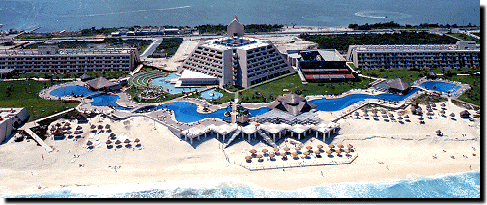
The conference was held at the Oasis Hotel, Cancun, Mexico. Cancun is located off the northeast point of Mexico's Yucatan peninsula directly south of New Orleans, Louisiana, with unparalleled natural attractions: powdery white sand and coral beaches, and turquoise Caribbean waters. The average temperature in April is 26.7 C (80.06 F). There are over two hundred restaurants offering Yucatan specialties, Mexican and international food. It is easy to arrange excursions to important archeological Maya sites such as Chichen-Itza, Tulum, and Coba. There are direct flights and good air connections to many cities in Mexico and abroad. |
[Top] [Home] [All LATIN Locations]
Photos
|
Taken by Edgar Chávez Taken by Ricardo Baeza |
[Top] [Home] [All LATIN Photos]
Statistics
[Top] [Home] [All LATIN Statistics]